

63% of Americans are living paycheck to paycheck.
37% of Americans finish the month either breaking even or going backward.
The average U.S. home is now more unaffordable to the average American than at any point in history.
Why is our financial reality so hard? And why is it getting more difficult?
The common answers are: it’s the politicians. It’s the corporations. It’s the rich people. It’s capitalism. But none of those are the root cause. The real root cause is something the politicians never talk about. You will never hear it on the Senate floor. You will never hear it at a presidential debate.
Let’s go back to the 1600s.
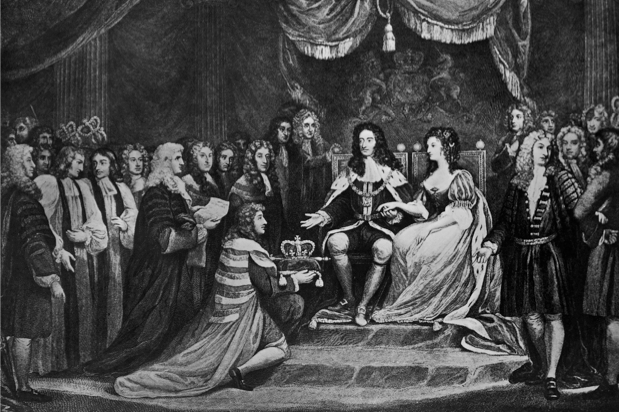
In 1689, William III and Mary II became joint rulers of England. Almost immediately, their country was pulled into a deep war with France. Shortly after, the English Navy was badly defeated, putting William and Mary in desperate need for military financing.
A Scottish merchant named William Paterson proposed an idea: the government could raise funds from the public through a new private corporation: the Bank of England.
The offer was simple:
Investors would provide £1.2 million in capital to the new Bank of England.
The investors would receive stock in the Bank.
The Bank would lend the £1.2 million to the government, putting the government in debt, but giving the country the money it needed to finance the war.
In return, the government would pay the Bank 8% interest on the loan.
Investors would get stock in the Bank. The government would get financing. The Bank would make profits in the form of interest. This was the birth of the Bank of England: a private bank created to fund a war through government debt, with the bankers ultimately profiting.
After its initial establishment in 1694, the Bank of England no longer turned to investors for money. They simply created paper banknotes and lent them to the government, supposedly backed by gold, however the paper money issued was past the proportional amount of gold reserves, a practice known as fractional-reserve banking.
Here’s the short version:
A group of bankers created a money system that enabled them to create money, lend it, and earn interest on it. The government received special access to the central source of money creation. In return, the government wrote the bankers’ system into law, giving the bankers the exclusive privilege to issue and control money, ensuring that the government could always receive financing, and the bankers could always earn interest. This was all the way back in 1694.
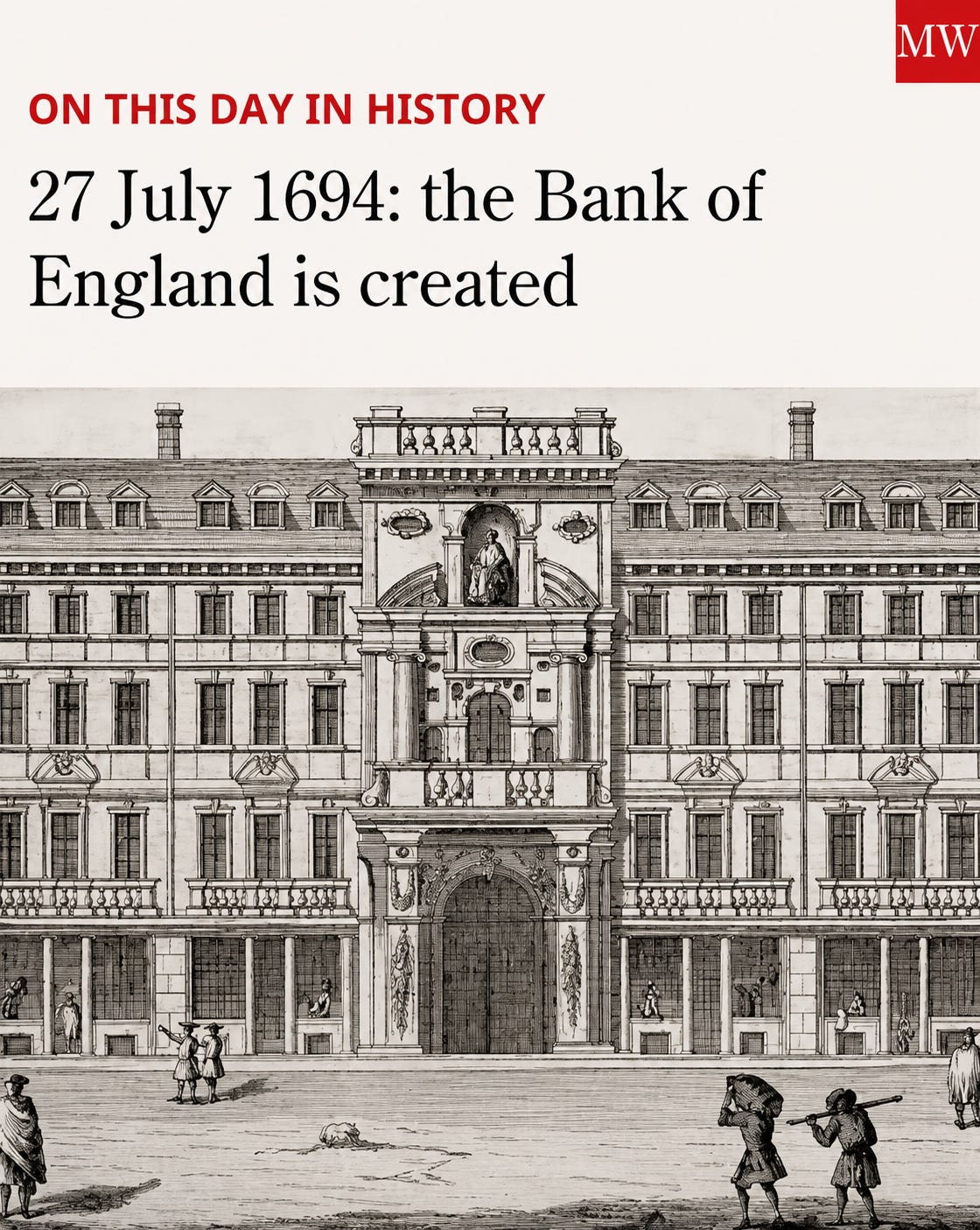
Now look at what happened at Jekyll Island in 1910. A group of bankers and politicians met to discuss the creation of a money system that enabled the bankers to create money, lend it, and earn interest on it, including the creation of a central bank that the government would have special access to. The government would sign it all into law, ensuring the money system was a monopoly. Three years later, the Federal Reserve was created.
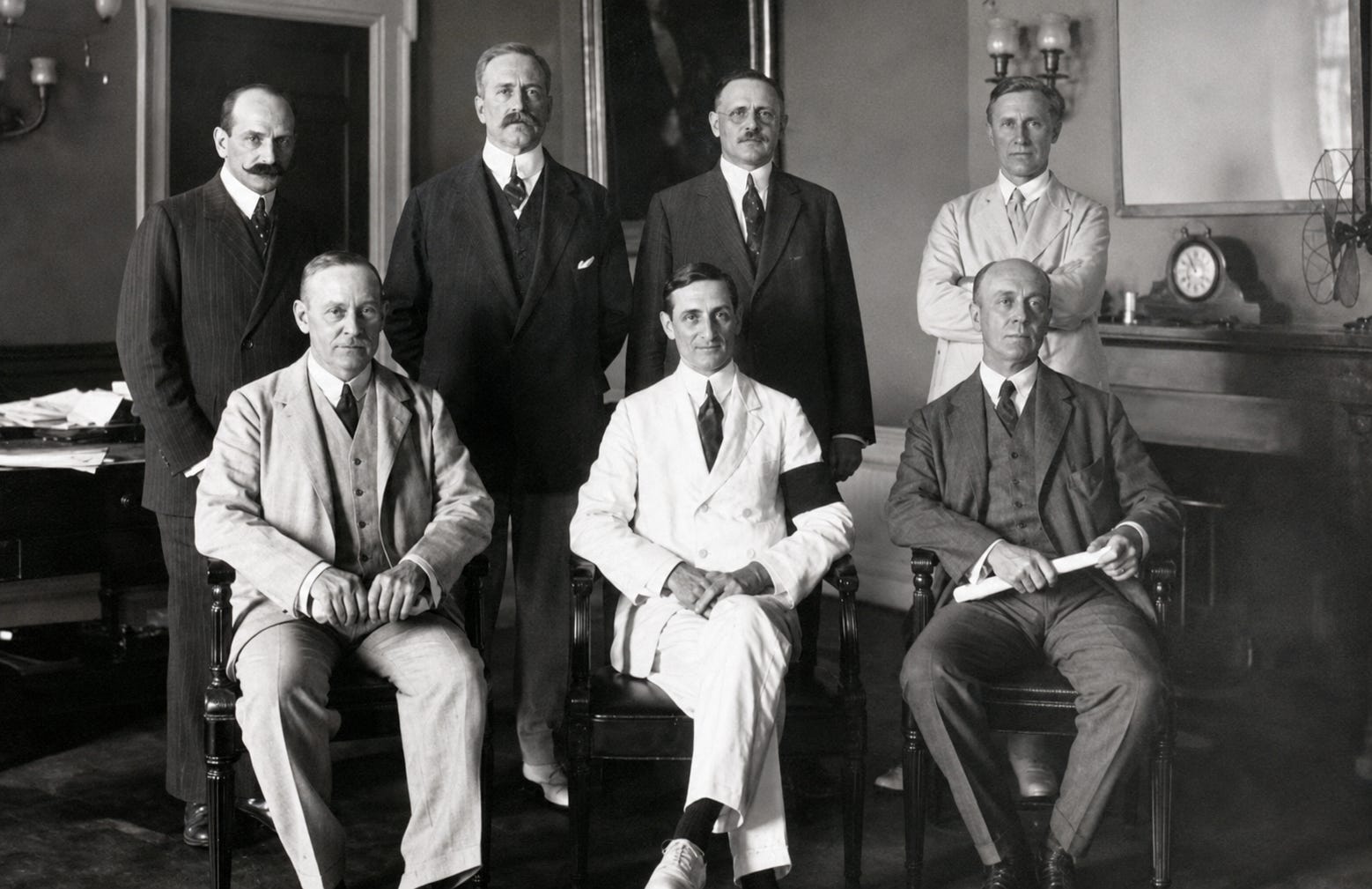
(pictured: the seven men that met at Jekyll Island to formulate the Federal Reserve. Paul Warburg, in the top left, spearheaded the blueprint.)
You are in a debt-based money system. That is the system we have right now. 97% of all money that is created comes from bank loans. Of the remaining 3%, 95-99% of that money is created through various forms of debt. Effectively, all of the money in existence is debt. The money is debt, and debt is the money.
What’s the reason for this? A debt-based money system allows the people who create the money to earn interest on their money creation. The money system is a business: the executives are the central banks, the employees are the private banks and the government, and you are the customer. The way the business makes money is through interest earned on debt creation, which makes the aim of the business extremely simple: Issue as much debt as possible so you can earn as much interest as possible. Make the whole thing run on debt. Make governments run on debt. Make families need debt. Make everyone use credit cards. Student loan financing, auto financing, home financing, Chipotle burrito financing.
The bankers had a problem, however, when money was on the gold standard. The money was supposed to be backed by gold, which limited the amount of money the banks could issue. What did that mean? Business revenue was limited. Given the choice, it is better if business revenue is unlimited. Without gold backing, banks could issue an unlimited amount of money and earn an unlimited amount of interest. In 1971, President Nixon removed the U.S. Dollar from the Gold standard.
Today, there is over $353 trillion of total global debt. Now you know why.
That’s the system you are in. It’s called the “fiat” system, where governments, in partnership with their central banks, decree their money to be the money. There was never a vote. Citizens did not have a say. The fiat debt-based system was decreed from the top down, and you are living in it.
Now that you understand the system at its roots, you can start to see why your financial life gets harder every year. This is explained through the mechanics of a debt-based system.
In fiat’s debt-based system, the money comes from bank loans. But when those loans are repaid, the banks destroy the money. They create money out of thin air and destroy it out of thin air.
If banks stopped creating new money, loans would be paid off, and the money supply would decrease. But there would still be a huge mountain of debt in the system from financial debt instruments, government debt, student loans, mortgages, credit cards, and other forms of debt. But because the money supply has decreased, there are fewer dollars circulating to service that mountain of debt, making the debt harder to pay off. That would cause defaults, business failures, and bankruptcies. Thus, the system needs constant new money creation, for two reasons:
To ensure there is money circulating in the economy.
To keep the system alive. No money creation = the money supply contracts and the debt-based system collapses. New money creation makes the debt easier to pay off and keeps the system afloat.
The fiat debt-based system constantly needs new money to be created. And what is this new money creation called? Inflation.
Inflation is not prices going up. Inflation is the money supply expanding. Prices go up because the money supply inflates, just like rubber duckies in a bathtub go up because the water supply increases. The rubber duckies going up is not inflation, it is a symptom of the underlying inflation. (the government cannot tell you that inflation is actually the money supply expanding, because then your awareness would be pointed to the expansion of the money supply, which is the fundamental basis of the entire system. Instead, they tell you inflation is prices going up, and most people don’t look past it.)
In the fiat system, inflation is both mandatory and constant. As a participant in the fiat system, guess what you get to bear the weight of? Mandatory, constant inflation. What happens as a result? Your money loses value over time. Prices rise. Both forces work against your financial life. Both forces make your financial life harder.
The U.S. dollar supply inflates at roughly 6.92% a year, call it 7%. What does that mean? That means your money is being debased at 7% a year. “Debased” is a synonym for “devalued.” The Dollar is losing 7% of its value every year.
If there was a stock that lost 7% of its value every year, and I told you, “Go work to earn that stock every single year of your life,” how would you react? You’d probably say something like, “Why would I work to earn something that loses value every year? How would that make my financial life easier?” It wouldn’t. That’s the point.
Now imagine you weren’t aware that you were working every week for something that constantly lost value. You would feel an invisible, antagonistic force hitting you every day. A year would go by, your financial life would be harder, and the invisible force would still be there. Now understand that this is the exact reality for the vast majority of Americans, and not only Americans, but the vast majority of all humans. A fiat central bank is connected to every single country on planet Earth.
If you don’t get a 7% pay raise every year, you pay the price. Of course, awareness of this builds, be it directly or indirectly. Nature is an adaptive intelligence, so what is the natural response to holding money that loses 7% of its value every year? Don’t hold it. “Invest your money in index funds. Buy real estate. Get a financial advisor.” But none of those are true solutions. Why? Because they all exist within the same system that caused the problem. The only solution is to move into a different money system.
Fiat money is the biggest problem in the world, and it is also the least understood (because there is an incentive for it to be the least understood (the fiat system does not work if you are aware of it, see day 1 of my exposing the money system series)).
It follows that the solution to fiat money would be the biggest solution in the world, and also the least understood. The biggest solution in the world would also be the most valuable solution in the world. Now, let me ask you, what has increased in value the most since 2009?
Your financial life doesn’t have to get harder every year. The solution is here. All that remains is understanding.