

This is part three in my series “I Studied Money for 10,000 Hours. Here’s What Actually Matters”
You can read part one here and part two here.
What changed most about my own relationship with money?
After studying money for 10,000 hours, what changed most about my relationship with money is my experience and understanding of the dollar system and the fiat system in general.
I cannot emphasize this enough.
When you spend that much time studying money and digging into the current system that we’re in and the actual solution to the system, everything in the world starts making so much more sense.
I remember in fifth grade, I got eye contacts for the first time. I went to the eye doctor, and I spent three to four hours trying to literally put contacts into my eyes. I was struggling to do it.
But once I got both of the contacts in, I remember I looked out the window of the building and the world was in HD. I couldn’t believe the world that was in front of me. Everything was 4K clear.
Seeing the current system and understanding money, the history of money, and Bitcoin as the actual root-level solution to the system, it’s that contact eye-doctor experience times a thousand. And that’s a massive understatement.
I can walk into a grocery store and understand why I’m reading a paragraph of ingredients. I can understand what causes reality to shape itself into that form, to actually produce this slop in front of me that’s making people sick and diseased. I can understand why our food is getting worse over time.
(Hint: the money is getting worse over time)
I can see how inflation affects producers and how that affects the experience of consumers.
I can understand why we have tens of trillions of dollars in debt.
I can understand the perpetual war machine that we have, and I can understand how to make war unaffordable.
Which, as I’m writing this, I’m looking at this beautiful, pencil-drawn, hand-drawn work of art that was produced as 1 of 210 by an artist named Bitcoin Apex.
It’s called Peacemaker, and the top of the drawing reads Forge Blocks, Not Bullets.
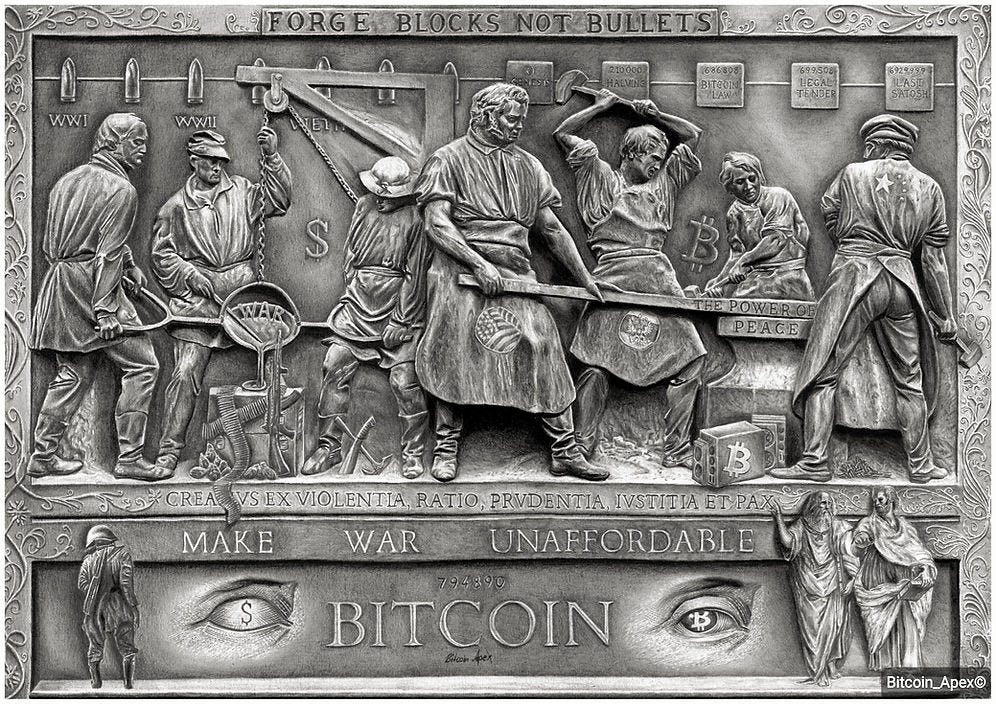
The fiat system forges bullets.
It manufactures war because war is a business for the fiat system. Why is war a business? Because debt is the money. Thus, if you’re creating something that needs more money, you’re creating something that needs more debt.
One of the largest expenses for a country and for a nation is going to war.
Central and private bankers make money on interest earned from debt issuance. That’s their business model. And that’s what the money is — debt.
Thus, one of the largest opportunities to create a bunch of debt and earn interest on it is going to war.
The playbook then becomes: manufacture war, create huge needs for debt, issue that debt, and earn huge amounts of interest.
Just like J.P. Morgan did in 1915.
The United States wasn’t even involved in World War I at the time.
But England and France came to J.P. Morgan in New York City and said, “Hey, we could use a bunch of money to finance this war that we’re in.”
And what did J.P. Morgan and his consortium of bankers do?
They created and issued the single largest financial loan in world history at that point. $500 million, created out of nothing but a credit agreement, which was made possible as all war-fighting nations and their allies had removed their money from the Gold Standard (just a weird coincidence…), which let them issue money unbacked by gold.
The day the loan was signed between J.P. Morgan, England, and France — and I discovered this in the process of writing my book, The Bitcoin Thesis (the full story is in the book) — everybody was gathered on the second floor of the J.P. Morgan building. Once the pen signed the dotted line of the credit agreement, the bankers started clapping.
You had a group of bankers celebrating, giving a huge round of applause for financing a war that killed more humans than any war in history at the time.
The bankers could care less about the war, they’re not fighting or putting their lives at stake. They’re making money off of it. They’re cheering for the war.
That’s when you start getting into the incentives of the business and the entire fiat system, which is to issue debt and earn interest from it.
“How do we do that?”
Let’s make the whole system run on debt.
Let’s make governments run on debt. Let’s make aspiring college students need debt. Let’s make families need debt. Let’s make everyone use credit cards. Let’s make everyone buy cars and houses with debt financing.
This is how you get a system that now has over $350 trillion of debt worldwide.
What does that mean?
The people issuing the debt, the private bankers — who are the people who created the system (see my post here on that story) — that’s how they earn money.
There’s hundreds of trillions of dollars of debt. The bankers are making a shit ton of interest from it, which is exactly what the fiat system wants. It’s what the system incentivizes.
Let’s create a bunch of wars constantly so we can create huge needs for spending, a.k.a. money, a.k.a. debt, and that gives us a bunch of interest. We get to line our pockets and get rich.
You take it to today… there’s a war that happens and then all of a sudden we’re at war, and people are like, “Why are we fighting this?”
Once you understand money, you can understand the answer: In the fiat system, there’s an incentive to be at war.
Someone gets rich off of the United States, or countries in general, being in a war.
Who are those people that get rich off it?
Those are the people that not only designed the system, they control the system.
They have control of the money printer. Their hands are on the money printer, which means they also get to start buying off and paying people to get into positions of power, a.k.a. the government, a.k.a. lobbyists, a.k.a. foreign politicians.
Look at the politicians who get elected.
These are the people who get the most donations, the most money, that then rise to power, that are then puppets who play out the system so that more debt can be issued. That’s the whole game. Whether it’s in the United States or in Bangladesh or in Africa, wherever it is, through the IMF, through the World Bank… Let’s make sure that we’re issuing debt and lining our pockets with interest. We can use our control of the money as a tool to shape the world, the system, and positions of power to make sure that we’re able to issue more debt.
That’s how the system operates.
That’s what has changed the most for me. I can see the root-cause.
I used to be a high school student who despised the school system I was in.
I went to government school all 12 years of my education.
I hated school.
Every day, I was like, “Why am I learning about these things? I’m not even interested in learning about these things. I feel like I’m wasting my time and my energy.”
I’m being told what to learn, and I’m not even learning things at school. I have to go home, do the homework, and, as crazy as it is, teach myself so that I can come back into school, take the tests and the quizzes, get the grade, and then say that I did it.
Even though now I couldn’t tell you 95% of the things that I learned, because all that I was doing was jamming information in right before a test or a quiz to earn a grade. To say that I did a good enough job.
“This sucks. What is this?”
That’s why I decided not to go to college, because, if I did, I was going to continue down that path. In my vision, going to college usually meant that what followed was plugging into the 9-to-5 world, which was the traditional experience of adulthood that mirrored the same exact system and experience that I so despised.
I said to myself, “Let me not go that way. Let me go this other way.”
And then, through the fate of the universe and the fate of God, and as nature would have it, I ended up stumbling across Bitcoin after making the worst investment decision of my life, monetarily speaking, which caused me to reset everything and start learning what I actually believed about investments, all based on the question: where is the best place to put my money?
I learned about many different asset classes, but I kept coming back to Bitcoin for various reasons.
Shortly after, I realized Bitcoin is the best place to put my money, because it is superior money.
Along the way, you learn about the current system that we’re in and how that contrasts with Bitcoin. You start to realize and gain clarity on how this current system is operating. You understand why government school is the way that it is, how government school is actually hindering the private side of schooling and the actual learning and development of our younger generations. You see how much creativity is being zapped out of kids every single day around the country and around the world as a result of government school.
My entire experience with money, which is all around me and all around us practically every day, has been transformed.
No matter what room I’m in, money is shaping that room. It’s shaping the energy in that room. It’s shaping the lighting that’s in the ceiling. It’s shaping the food in front of me. It’s shaping the prices on the menu. It’s shaping the clothes that people are wearing. All of these things, and that’s just a small list of many.
There’s clarity on it. There’s understanding. And there’s this stable foundation that comes with it.
When you not only understand money, but when you’ve shifted to the system that is the true root-level solution to money, which is Bitcoin…
When you shift into that system, I can’t even explain to you how stable and true of a foundation that is for me to rest my head on at night and experience the world through.
It is infinitely worth it, literally and figuratively.
If you enjoyed, consider subscribing or sharing this post