

This morning, you woke up. You went to work. And you exchanged another piece of your life for a very particular thing.
That “thing” has a name:
Money.
But you didn’t trade your lifeforce for “money,” you traded it for a certain form of money.
After studying money for over 10,000 hours, I realized that the number one thing that most people misunderstand about money is the actual money they’re using on a day-to-day basis. Hours, years, decades of your life, spent working for a certain form of money, and yet most people don’t understand what that certain form of money is. And I don’t mean the name of it. I mean the nature of it. The properties of it. The functions of it.
Think about that… Most people spend decades of their lives working for something they can’t explain. It’s like spending decades of your life playing basketball without ever understanding what basketball is. It’s an insane thing to imagine. But I promise you it pales in comparison to the insanity of the current money system.
Then there’s the next piece of understanding, or the lack of it, which is:
What is money supposed to do for me?
Most people can answer that. They’ll say something like, “I work a job so I can earn money. That way I can pay for things. I can buy groceries. I can pay rent. I can save and invest and hopefully grow my wealth to buy a home someday and provide for my family.”
More or less, that’s the answer you’ll hear. But deeper, at the core essence of money itself, what is money supposed to do for you? What is money supposed to do for everybody?
The purpose of money is simple: transfer value across space, scales, and time.
That’s what we use money for.
We use money to take value from place to place, across oceans, from home to the grocery store. With money, we transfer value across space.
Money also transfers value up and down the economic scale. If you want to exchange your value for a house, if you want to buy a pack of gum, money is the tool you use to do that.
Lastly, money is supposed to transfer value across time. You earn money today. You want to be able to use it tomorrow, a year from now, 10 years from now, 40 years from now, and have its actual value held such that you can exchange its value for another piece of value. Groceries, vacations, raising a kid, and so on.
That’s what money is supposed to do: transfer value across space, scales, and time.
The slightly more esoteric layer is that money is supposed to represent your time and energy most effectively, because that’s what you’re exchanging in order to earn money. You give your time and energy to the market in order to receive money.
If you start a food truck, you’re expending your time and energy. Both the time and energy that you’ve spent in the past learning about food, what recipes you want to use, cooking skills, how to cut an onion, and then the time and energy that you’re spending to buy the ingredients, build relationships with vendors, actually get the food truck, advertise it, build out your menu. Then you bring the ingredients together. You make food. And you sell it.
Someone buys your food and gives you money in exchange. That money represents the time and energy you spent to earn it.
That’s the deeper layer of what money is supposed to be doing: it is representing the time and energy you have given to the market.
So now, imagine if the money you’re using is going down in value.
What does that mean?
The money you’re using is going down in time, and it’s going down in energy.
That means you have less time, and that means you have less energy.
The result?
You have to work more. Life is less affordable. You need to invest your money to make up for the loss.
Then you realize… that’s the exact experience of people who use the U.S. Dollar and all fiat currencies, which are guaranteed to lose value over time because of inflation.
Some people would stop there. Not here. It goes deeper.
Why is inflation required? Why do we have inflation?
Inflation is required because the Dollar, and the wider fiat system, is a debt-based system.
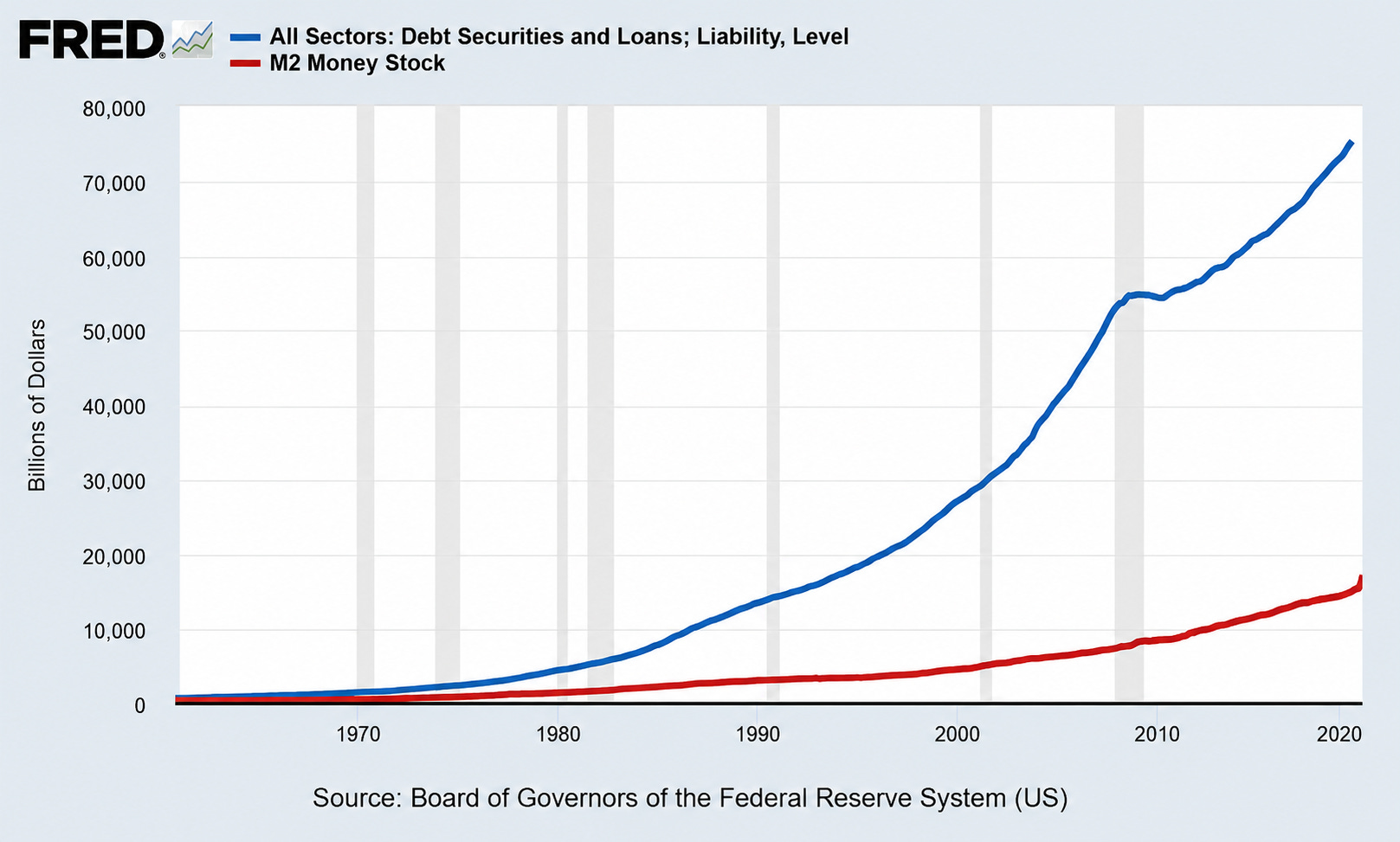
In this system, there’s an endless number of debt claims made, but money isn’t necessarily created when that debt claim is made. For example, when you use a credit card, you’re not actually paying with money. You’re paying with a debt claim. The hope is that you’ll receive actual money at some point and pay off the debt claim. When you extrapolate this out to the whole system, it results in there being more debt than there is money. Debt claims are constantly being created, but that does not mean that the money to pay off the debt has been created. The gap between debt claims and money is evidenced here:
Okay, but what does this mean?
If there is less money than there is debt, there has to be more money created to pay off the debt. If not, then when the debt comes due, there wouldn’t be money to pay for it, causing the debt to collapse down to the actual amount of money that there is.
When you have an entire system that functions this way, it creates constant systemic risk, because there is constantly a gap between debt claims and money. If no new money is created to pay off the endless number of debt claims, the system would collapse. People would go bankrupt. Companies would default. Governments wouldn’t work.
In the debt-based system, there HAS to be new money creation. It is a built-in requirement to keep the system alive. That “new money creation” is what inflation is — and it is what causes price inflation. They create new money, and then prices rise (COVID is an easy example of this).
What is another side effect of the system’s mandatory inflation?
The Dollar loses value. And what do you do? You spend decades of your life working for the Dollar. Which is losing value. Which is losing time and energy.
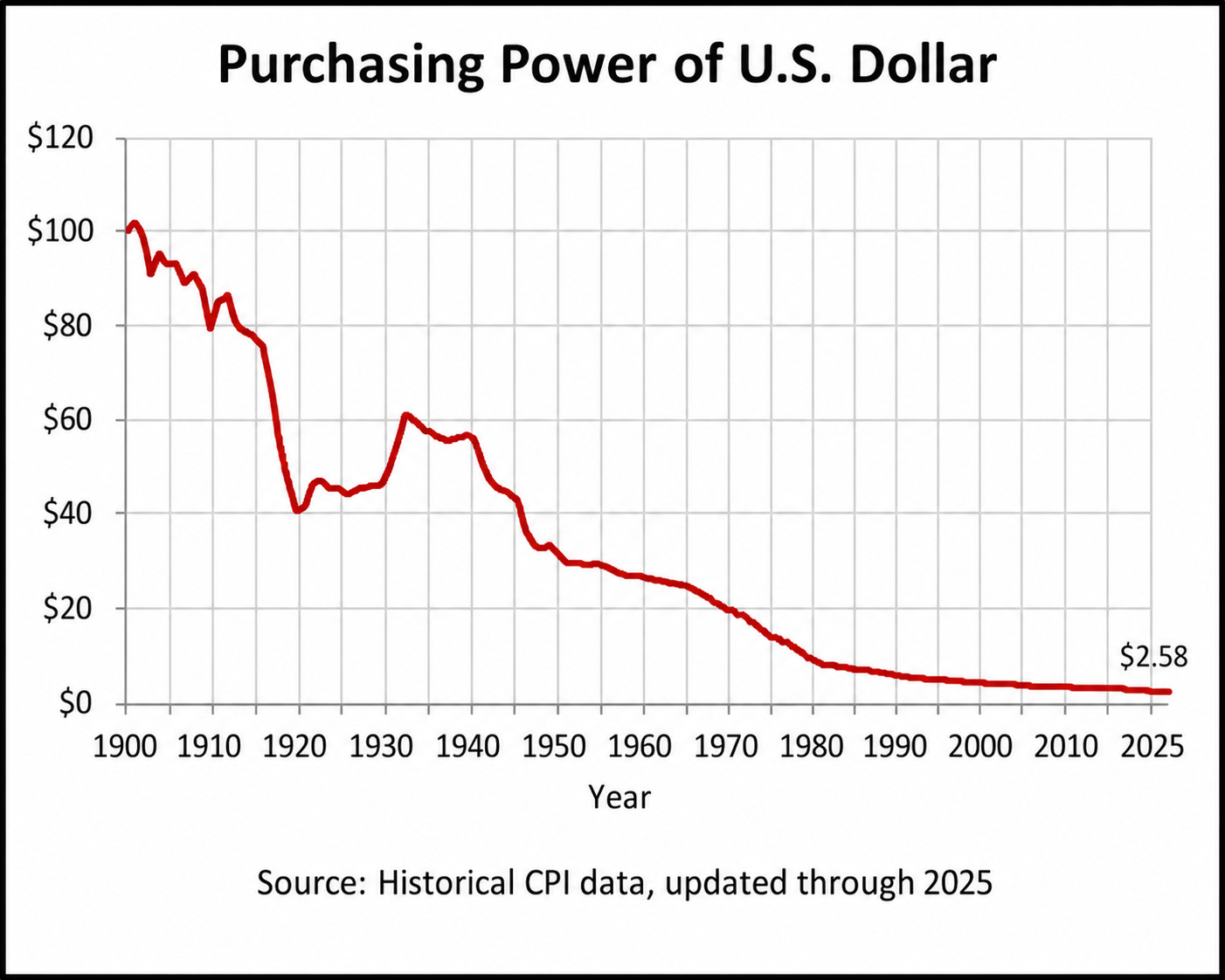
You’re exchanging your life for something that is constantly losing time and energy.
The debt-based system that you are in is a backward force. The money you’re using and working for is losing value. You want financial freedom, but the fundamental tool that represents financial freedom is working against you. It’s like rowing a boat against the current. The Dollar is making your financial freedom more difficult every year because it is losing value every year. It is that simple.
Imagine if you held a stock that lost 7% of its value every year while trying to build financial freedom.
With the Dollar, and all fiat currencies, you’re spending decades of your life working to earn a stock that loses value every year.
And if you don’t understand that, if you don’t realize the nature of the Dollar, you feel this invisible antagonistic force working against you every day of your life, all while you participate in this reality and system of money.
This is why it’s so important to understand money. If you don’t understand the Dollar, you feel this huge, vague, constant, stressful money problem, and you have no idea where it’s coming from or how to actually fix it.
Then you realize… this is exactly why most people have this huge, vague, constant ball of money stress surrounding them at all times. They don’t understand the form of money they’re using, which means they don’t understand that it’s the money that’s working against them.
The single most important financial decision you will ever make is what money you will use. Why? Because the money you adopt is the thing that you’re exchanging decades of your time and energy for. You are saying, “I will trade decades of my life to earn this particular form of money,” and most people don’t even think twice about what that form of money is.
The vast majority of the world woke up this morning and went to work for money that made their financial lives harder.
Next year comes around and they say, “Why is my financial life harder? God, this system sucks.”
“It’s got to be the politicians.”
“We should tax the rich.”
“It’s the corporations. They’re raising prices. They’re causing inflation.”
No.
It’s the money.
The money is the system.
The political nonsense, the growing wealth gap, the corporations raising prices… they all sit on top of the same foundation: the money system.
The system is what enables monetary corruption. It lets central banks, in partnership with their politicians and closest confidants, print an endless amount of money to pay for whatever they want.
That is why there’s no debt limit. That is why we have $40 trillion of debt, because we’re in a money system that has an endless stream of money available to the government. What do you think they’re going to do?
Of course they’re going to take advantage of it. They’ll promise X, Y, and Z to voters and say, “Hey, we’ll take care of you. We’re going to spend more on education, tax the rich, and spend on these welfare programs to give you support and help.”
The system promises you things, and can “deliver” on them, because there’s no actual discipline to their spending. There’s no limit. They can spend and promise as much as they want, which is what they’re incentivized to do so you can vote them into office.
But that spending causes more debt. Which necessitates more inflation. Which makes your life even harder, putting you in greater need of support, raising the incentive for politicians to promise you more things.
The politicians are promising things in an attempt to solve problems from the same system that caused the problems. Which is why their promises never work. And that promise, and the delivery of that promise — which can happen because the money supply is infinite — is making the system worse, which makes your reality worse, creating more promises, more spending, and more debt.
It’s a negative feedback loop, and you’re in the middle of it.
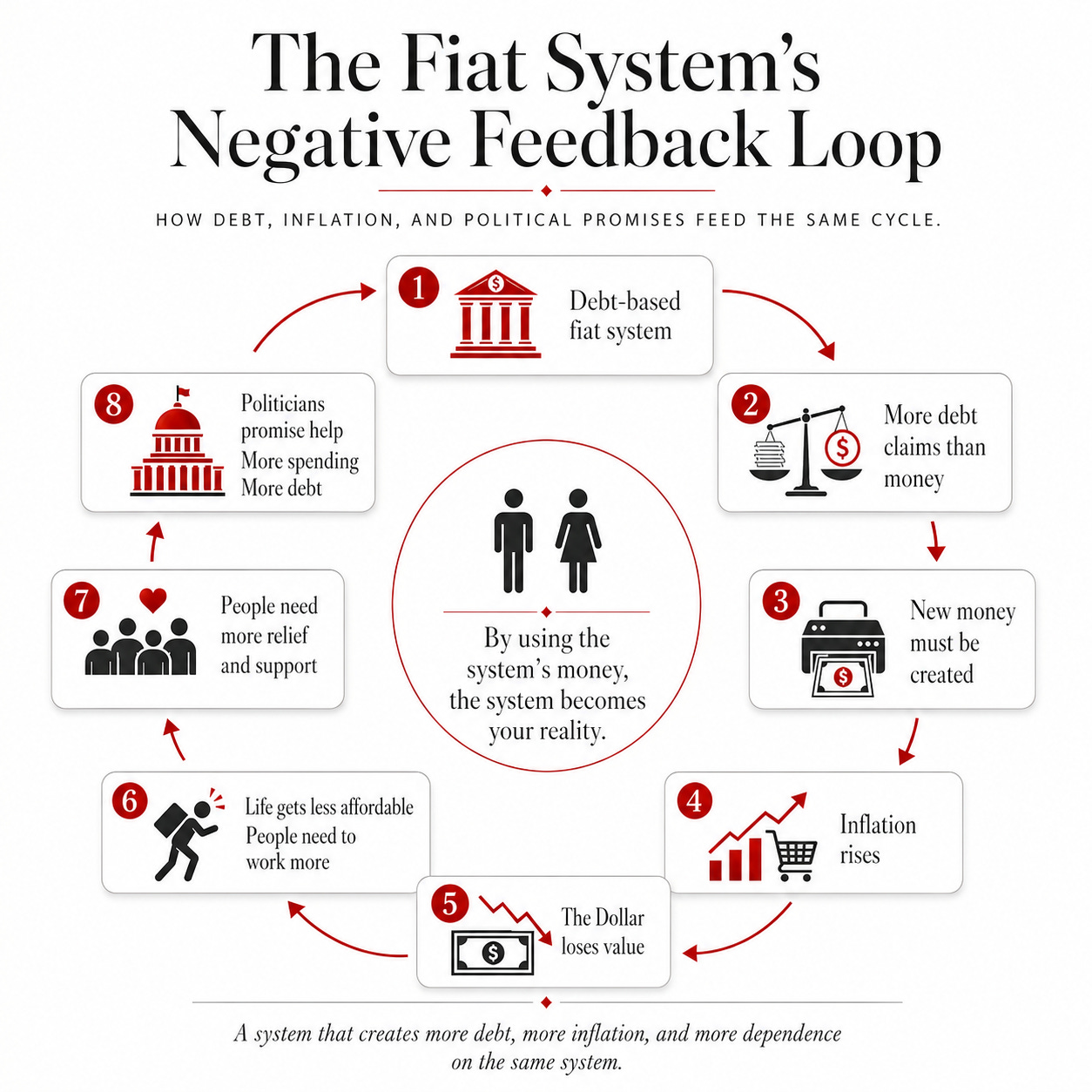
As long as you’re using the U.S. Dollar, or any fiat currency, this is your experience.
This is part one of a six-part series titled, “I Studied Money for 10,000 Hours. Here’s What Actually Matters”
Part two will be released later this week.
Feel free to share this post with anyone who may find it valuable.
A great stack, Thank You. An enjoyable read and thought-provoking. What most people will never get to the point of, what is money and what are they really working for?
As AI/robotsI and UBI moreso slowly come into life, some will carry on the same. Others will question the nature of their money and the money system they use.
Crazy when ppl buy something, they compare different options before buying. People don't do that with money. Most think there is only one form of money and have to use only that one type.
Hopefully more people soon realise what money is at it's base level and make different decisions and see there are alternatives. Money is not just in one form/system; and there is the option to compare different money systems and choose the one best for them.