

1. What do people spend way too much time worrying about when it comes to money?
They spend too much time worrying about their “external world of money.”
This is budgeting, finances, and making more money/earning more income.
“I’ll save more money by not spending $7 a day on my Starbucks coffee. I’ll cancel my Netflix subscription. I’ll buy cheaper food (which comes back to bite you down the line). I’ll save more so I can invest in the S&P 500.”
Then there’s the income side, which usually entails chasing a higher-paying job: “I’ll go work in finance so I can make more money.” Which brings up an important point.
“Finance” sits at the center of the current money system, which creates a hyper-financialized world. But why? Why is finance at the center, and why do we have a hyper-financialized world?
Because the money is broken: the money loses value over time, which means it fails to fulfill the purpose of money: transfer value across space, scales, and time.
Because the money loses value over time, the world has to create financialized products to compensate for the loss.
“Let’s create an index fund.”
“Let’s create a real estate investment trust.”
“Let’s create a mutual fund.”
“Let’s create hedge funds and private equity firms.”
“Let’s invest in houses, not as houses, but as investments, to make up for the money failing to do what it’s supposed to do.”
The core of the current system is monetary inflation. That inflation debases the money, causing it to lose value, which causes enormous amounts of energy to flow toward making up for that debasement. Which is the entire world of finance. Which is Wall Street. Which is all of the BlackRocks and Vanguards and the hyper-financialized world that we’re living in.
A lot of money flows to “finance” because the need for a solution is so incredibly vast.
How many people are using money that loses value every day? Practically everybody.
Well, then, that many people need a solution to that problem. But the system does not want to produce an actual solution (a different money system) because then the system would lose energy and wither away. Instead, the system produces a “solution” in the form of an adaptation. A product. Something that makes up for the difference, that makes the debasement of money feel better, but still keeps you in the same system. This is finance. And because both the need and the potential for a solution are so vast, there are plenty of high-paying finance jobs to go around.
So then people go, “Oh, I need to make more money. Let me go work in finance. Let me go work at an investment bank or a private equity firm or somewhere on Wall Street, selling these financialized products that I don’t really enjoy making.”
“I don’t enjoy working here, but it makes me money.”
That’s all driven by this external/circumstantial world of, “Let me make more money so I can feel more financially free.”
2. What matters far more than most people realize?
The purely external view of money ignores the three other pillars of financial freedom, which are the three things that matter far more than most people realize.
The first pillar is the understanding of money, which we already talked about yesterday (linked here and also at the end of this article).
The second pillar is the system of money that you’re in (also discussed yesterday). Once you get the understanding of money, you realize, “Holy shit, this current system is fucked. This is not in alignment with my financial freedom. This is not in alignment with financial freedom, period. Let me think about, and seriously consider, moving to a different system that actually is in alignment with financial freedom and does what money is supposed to do better.”
Which is a very simple equation.
If you were given the choice between a plane that got you from Los Angeles to New York in two hours and a plane that got you from Los Angeles to New York in 20 hours, which one would you choose?
You’d obviously choose the better one.
With money, most people are like, “Money A transfers my value over time worse than Money B, but I’m gonna stick with Money A because it’s what I’m used to.”
But, in reality, most people never make it to that point, because they’ve never questioned the money that they’re using.
You would quickly lose interest in Money A if you understood money and understood that Money A is failing to do what money is supposed to do. You would see that Money B is the better choice because you understand the fundamentals of money, the properties of money, and what goes into making certain forms of money better at transferring value over time.
At which point you would say, “Holy shit, I’m going to get out of this system. I’m going to Money B.”
The third pillar of financial freedom — and this is one that gets as much neglect as anything — is your internal world of money.
This is how you relate to money.
This includes your beliefs around money that were installed (mostly subconsciously) either in childhood or at some point in your life. It could simply be from your experience in the current system, which makes money feel like it is scarce.
Understand that the system itself produces the energy of “not enough money,” because fundamentally, in the debt-based fiat system, there is not enough money to pay off all of the debt.
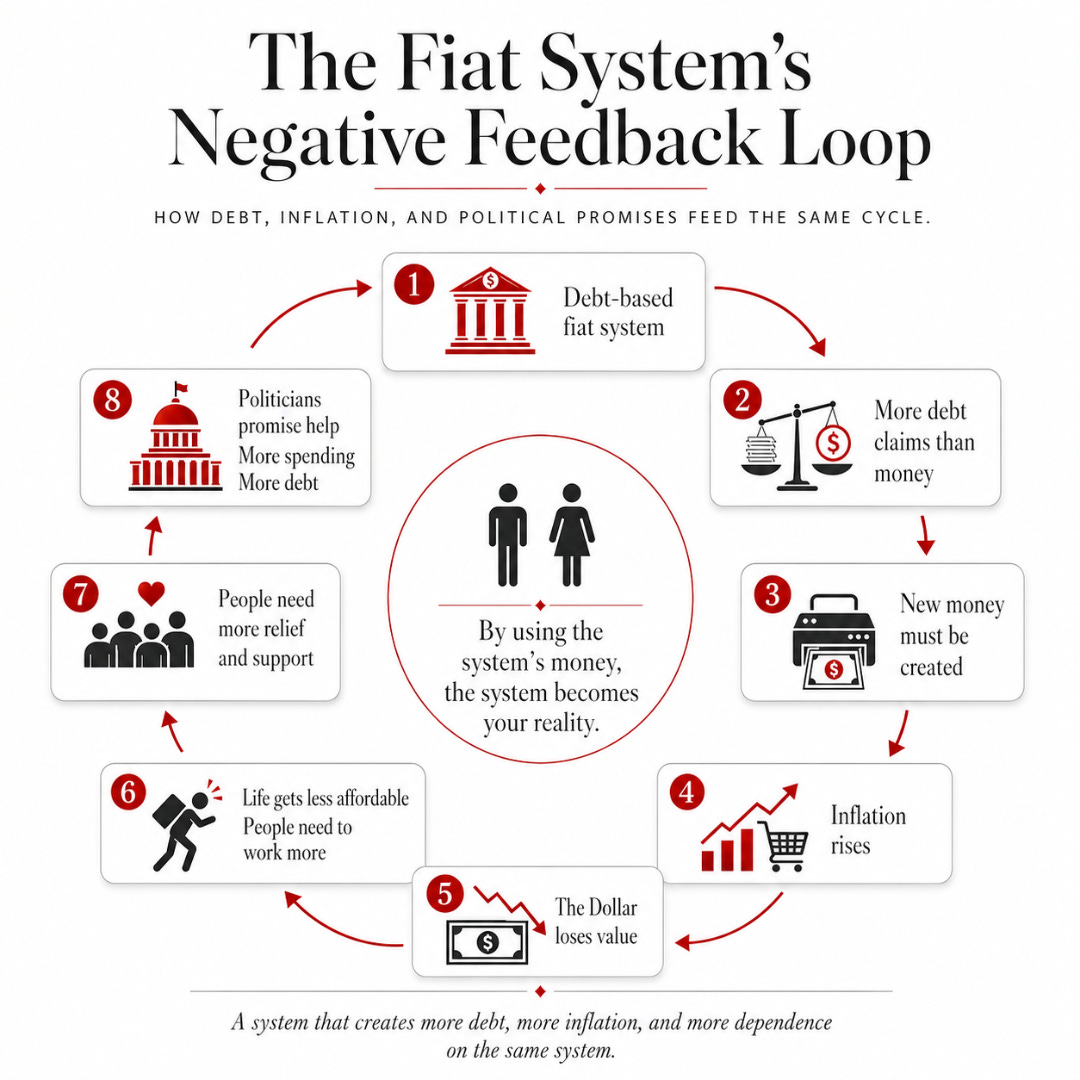
If you’re participating in that system, you pick up on that energy, and then you start to adopt the beliefs that money is scarce, that there’s not enough money, that you’re lacking money. That then becomes your experience around money.
Your internal world also includes your emotions around money.
If someone were to tell you, “You’re going to make $10 million this year,” how would your nervous system receive that energy?
Your nervous system capacity around money is a large determinant of your ability to attract large sums of money.
To some people, $10 million isn’t that much money. To other people, $10 million is so much money that their nervous system can hardly handle the thought of it.
People have different relationships with money, and that shapes their experience with money. It shapes their ability to attract money. It shapes their ability to provide value and earn value.
Deeper down, it shapes their alignment with financial freedom.
If you want to be aligned with financial freedom, align with the four pillars of financial freedom.
The external world is still important — budgeting, finances, and income. You don’t want to be recklessly spending. You want to save and be wise with money. But also… actually understand money. Understand the system that you’re in. Choose the system wisely. Start to dig into your internal relationship with money and move toward the advantageous beliefs and truths around money that expand your nervous system’s capacity to attract money, and watch as you naturally attract more money and feel more financially free than you’ve ever been.
This is part two of a six-part series titled “I Studied Money for 10,000 Hours. Here’s What Actually Matters”
Part one is here.
Part three will be released soon.